PYTHON TUTORIAL
Python tutorial provides basic and advanced concepts of Python. Our Python tutorial is designed for beginners and professionals.
Python is a simple, general purpose, high level, and object-oriented programming language.
Python is an interpreted scripting language also. Guido Van Rossum is known as the founder of Python programming.
Our Python tutorial includes all topics of Python Programming such as installation, control statements, Strings, Lists, Tuples, Dictionary, Modules, Exceptions, Date and Time, File I/O, Programs, etc. There are also given Python interview questions to help you better understand Python Programming.
What is Python
Python is a general purpose, dynamic, high-level, and interpreted programming language. It supports Object Oriented programming approach to develop applications. It is simple and easy to learn and provides lots of high-level data structures.
Python is easy to learn yet powerful and versatile scripting language, which makes it attractive for Application Development.
Python's syntax and dynamic typing with its interpreted nature make it an ideal language for scripting and rapid application development.
Python supports multiple programming pattern, including object-oriented, imperative, and functional or procedural programming styles.
Python is not intended to work in a particular area, such as web programming. That is why it is known as multipurpose programming language because it can be used with web, enterprise, 3D CAD, etc.
We don't need to use data types to declare variable because it is dynamically typed so we can write a=10 to assign an integer value in an integer variable.
Python makes the development and debugging fast because there is no compilation step included in Python development, and edit-test-debug cycle is very fast.
Python 2 vs. Python 3
In most of the programming languages, whenever a new version releases, it supports the features and syntax of the existing version of the language, therefore, it is easier for the projects to switch in the newer version. However, in the case of Python, the two versions Python 2 and Python 3 are very much different from each other.
A list of differences between Python 2 and Python 3 are given below:
- Python 2 uses print as a statement and used as print "something" to print some string on the console. On the other hand, Python 3 uses print as a function and used as print("something") to print something on the console.
- Python 2 uses the function raw_input() to accept the user's input. It returns the string representing the value, which is typed by the user. To convert it into the integer, we need to use the int() function in Python. On the other hand, Python 3 uses input() function which automatically interpreted the type of input entered by the user. However, we can cast this value to any type by using primitive functions (int(), str(), etc.).
- In Python 2, the implicit string type is ASCII, whereas, in Python 3, the implicit string type is Unicode.
- Python 3 doesn't contain the xrange() function of Python 2. The xrange() is the variant of range() function which returns a xrange object that works similar to Java iterator. The range() returns a list for example the function range(0,3) contains 0, 1, 2.
- There is also a small change made in Exception handling in Python 3. It defines a keyword as which is necessary to be used. We will discuss it in Exception handling section of Python programming tutorial.
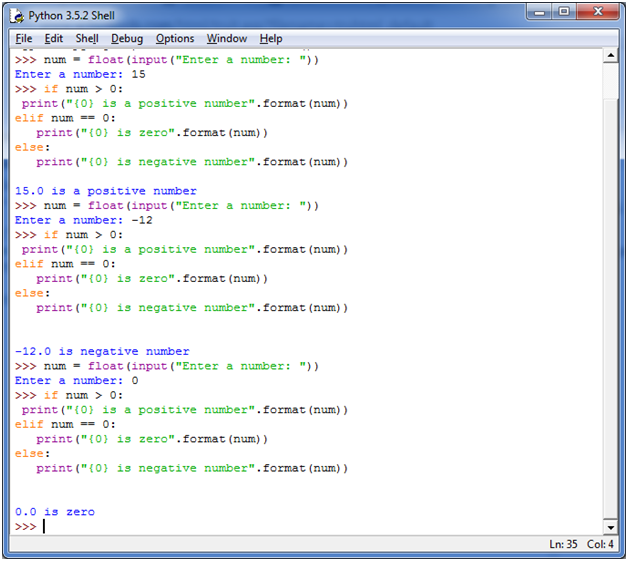
Python Program to check if a Number is Positive, Negative or ZeroWe can use a Python program to distinguish that if a number is positive, negative or zero. Positive Numbers: A number is known as a positive number if it has a greater value than zero. i.e. 1, 2, 3, 4 etc. Negative Numbers: A number is known as a negative number if it has a lesser value than zero. i.e. -1, -2, -3, -4 etc. See this example:
EXAMPLE:
Note:In the above example, elif statement is used. The elif statement is used to check multiple expressions for TRUE and executes a block of code when one of the conditions becomes TRUE. It is always followed by if statement. |


Comments
Post a Comment